The Bonabé Valley, at an altitude of 1,400 m in Pallars Sobirà, hosts an outstanding example of a protected habitat: petrifying springs that form travertine. Although it is located next to a forest track with easy access, very close to the Fornet refuge, it lies within the Alt Pirineu Natural Park and is therefore in a protected area.
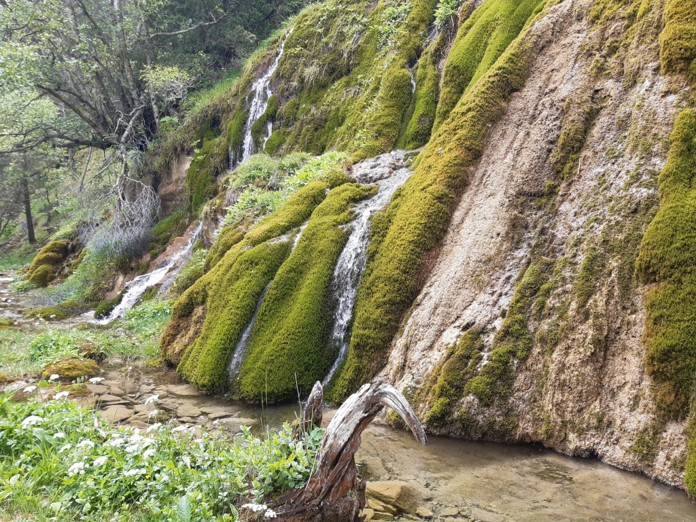
The waters descending from Pic des Miques, which are very rich in calcium carbonate (hard water), seep down a steep, several-metres-wide slope as they reach the Escala Alta meadow, forming a dense carpet of mosses nourished by this flow.
Over time, the water running over the mosses reacts with the air and precipitates calcium carbonate, which builds up into a hard crust. As the years go by, this process ultimately forms travertine.
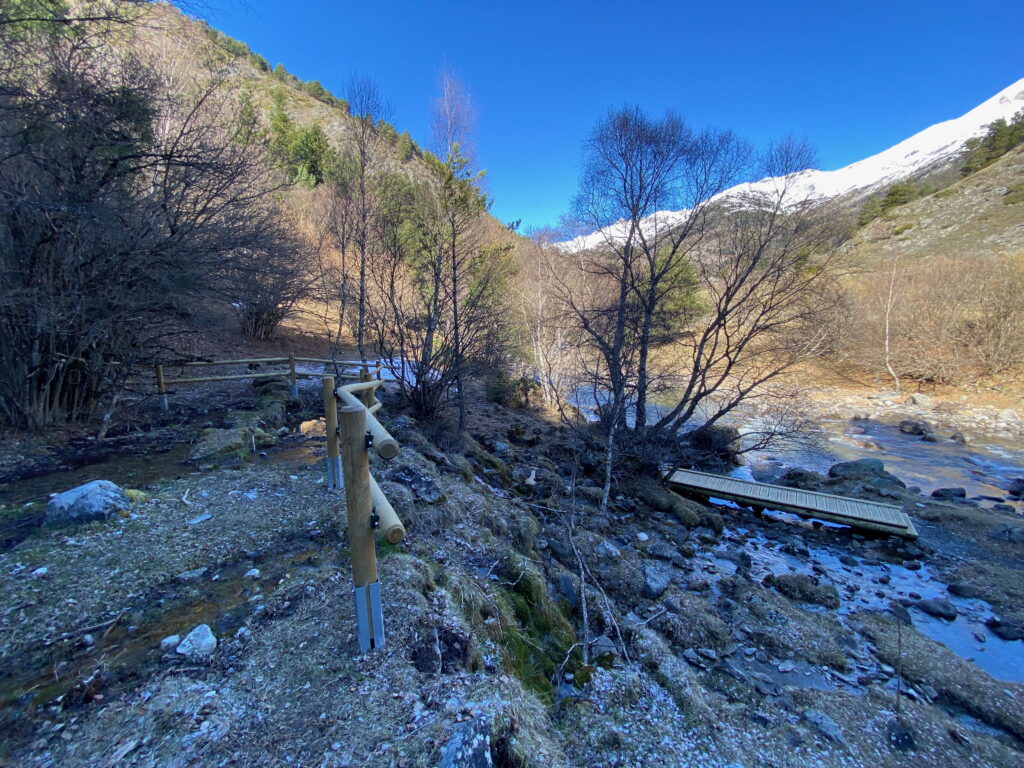
The Font de la Tosca in the Bonabé valley is cut halfway up the slope by an old path and a wall that used to drain the water downhill. The passage of people and livestock along the path weakened the wall, caused a separation of plant and moss communities, altered the natural flow of water (leaving part of the slope dry where the habitat could develop), and endangered the future viability of the ecosystem. The Alt Pirineu Natural Park has protected the Font de la Tosca thanks to the LIFE RESQUE ALPYR project, in coordination with the University of Barcelona. The route of the current path has been modified, and wooden walkways have been installed to allow visitors to appreciate the uniqueness of the site without causing any disturbance to the habitat. In addition, access by large animals and people is now prevented through wooden enclosures. All these actions are environmentally friendly and in line with the Park’s policies. An information panel will soon be installed for visitors, explaining the actions carried out, the uniqueness of the site, and its most characteristic species. A team of botanists from the University of Barcelona is responsible for conducting biological monitoring on the old path to detect whether the moss cover and travertine accumulation recover thanks to the physical protection of the site.